
Tennessee facts for kids
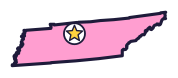
Tennessee, the Volunteer State (say ten-uh-SEE), touches eight other states. It shares the Great Smoky Mountains with North Carolina. In 1920, its vote helped American women win the right to vote.
Quick answers
- Where is Tennessee?
- Tennessee is in the Southeast region of the United States. It touches eight states: Alabama, Arkansas, Georgia, Kentucky, Mississippi, Missouri, North Carolina and Virginia.
- What is the capital of Tennessee?
- Nashville. It’s also the biggest city.
- Does Tennessee touch the ocean?
- No. Tennessee doesn’t touch an ocean or any of the Great Lakes.
- How big is Tennessee?
- 42,144 square miles. It’s the 36th biggest of the 50 states.
Tennessee at a glance
- Capital
- Nashville
- Nickname
- The Volunteer State
- Region
- Southeast in Map Otter. The US Census Bureau puts it in the South.
- Became a state
- June 1, 1796, the 16th state
- Biggest city
- Nashville
- Size
- 42,144 square miles, the 36th biggest
- People
- About 7.3 million (2025), the 15th most
- Neighbors
- Alabama, Arkansas, Georgia, Kentucky, Missouri, Mississippi, North Carolina and Virginia
Where is Tennessee?
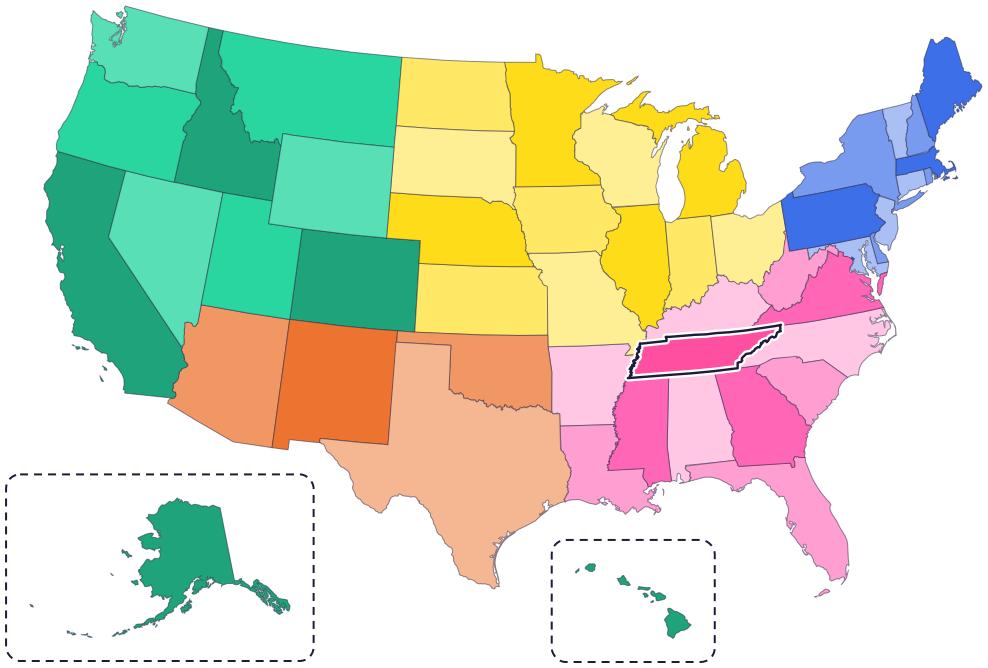
Tennessee is in the southeastern part of the country. It’s long and narrow, and it touches eight states: Kentucky to the north, Virginia to the northeast, North Carolina to the east, Georgia, Alabama and Mississippi to the south, Arkansas to the west and Missouri to the northwest.
The Mississippi River forms its western border, with Arkansas and Missouri on the other side. In the east, the Great Smoky Mountains run along its border with North Carolina.
Fun facts
- 1
For a few weeks each year, between late May and late June, some fireflies in the Great Smoky Mountains flash in unison. The firefly is one of Tennessee’s two state insects, along with the ladybug.
- 2
The Great Smoky Mountains get their name from the mists that often rise like smoke from them.
- 3
In 1784, settlers meeting in Jonesborough, in what is now Tennessee, voted to start their own state, called Franklin. By 1789, the idea had all but faded.
- 4
Tennessee’s state wild animal is the raccoon, and its state dog is the bluetick coonhound.
- 5
The state fruit is the tomato. The law calls it “the delicious tomato”!
Places to know

Great Smoky Mountains National Park
East Tennessee, on the North Carolina border
Tennessee shares this park with North Carolina. Its forested ridges are world renowned for their many kinds of plants and animals.
Cumberland Gap National Historical Park
Where Tennessee, Kentucky and Virginia meet
This mountain pass was the first great gateway to the West. About 300,000 people crossed the Appalachians here, and today you can stand in three states at once.

Pinson Mounds
About ten miles south of Jackson
At least 12 mounds built about 2,000 years ago. Sauls Mound is 72 feet tall, the second-tallest mound in the United States.
Tennessee long ago
People from as far away as today’s Georgia and Louisiana gather for ceremonies at Pinson Mounds.
On June 1, Tennessee becomes the 16th state. Its land had been part of North Carolina.
During the War of 1812, Tennessee’s governor asks for 3,500 volunteers. Tennesseans rush to sign up, starting the tradition behind the nickname “the Volunteer State.”
US Army troops and state militias force more than 16,000 Cherokee people from their homes in Tennessee and nearby states and send them west, on the Trail of Tears. More than a thousand die on the way. Today the Cherokee Nation’s headquarters are in Tahlequah, Oklahoma, and the Eastern Band of Cherokee Indians’ home is in western North Carolina.
In June, Tennessee voters choose to leave the United States, but East Tennesseans vote more than two to one to stay. The Civil War that follows ends slavery.
On August 18, Tennessee becomes the 36th state to approve the 19th Amendment, the last one needed. It guarantees American women the right to vote.
State symbols
- State wild animalRaccoonsince 1971
- State horseTennessee walking horsesince 2000
- State dogBluetick coonhoundsince 2019
- State insectsFirefly and ladybugsince 1975
- State treeTulip poplarsince 1947
Tricks to remember Tennessee
- A brick on its side. Tennessee is much wider than it is tall, like a brick lying on its side.
- Three stars, three parts. Tennessee’s flag has three stars, and by law the state has three parts, called grand divisions: East, Middle and West Tennessee.
- Double letters. T-e-n-n-e-s-s-e-e has three pairs of double letters: nn, ss and ee.
- Nashville is near the middle. The capital is close to the center of the state, a little to the north and west.
To practice, print a blank US map and color in Tennessee, or find it in the 50 states quiz. Then try today’s mystery state: guess it from its shape, with a clue after each miss.
Teaching all 50? Read how to teach kids the 50 states and what age kids learn the states and capitals, or follow our free 36-week homeschool geography plan.
Tennessee in Map Otter
In Map Otter, kids find Tennessee on the map, learn its capital, and collect its stamp in their passport, with Otto guiding the way. These screenshots show how it looks with a few example states.
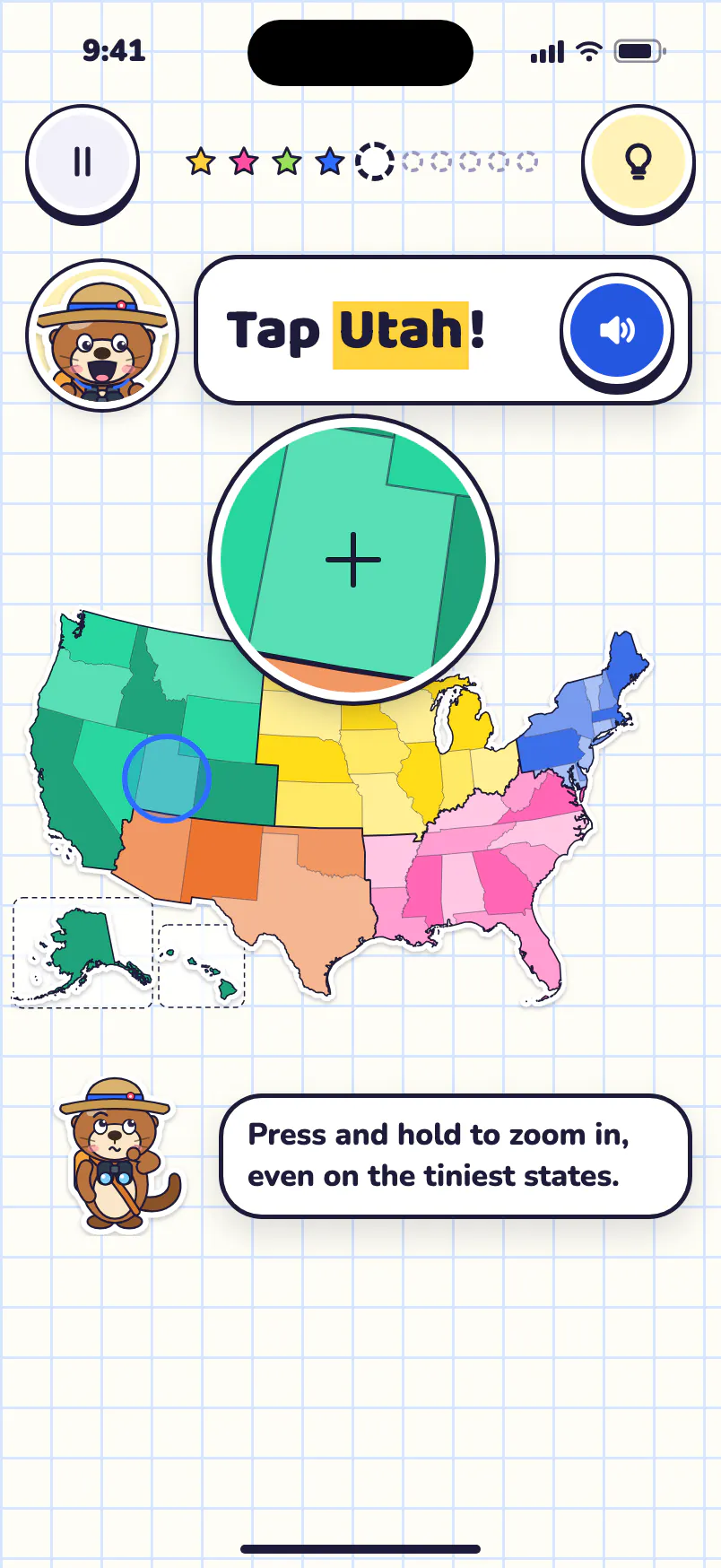
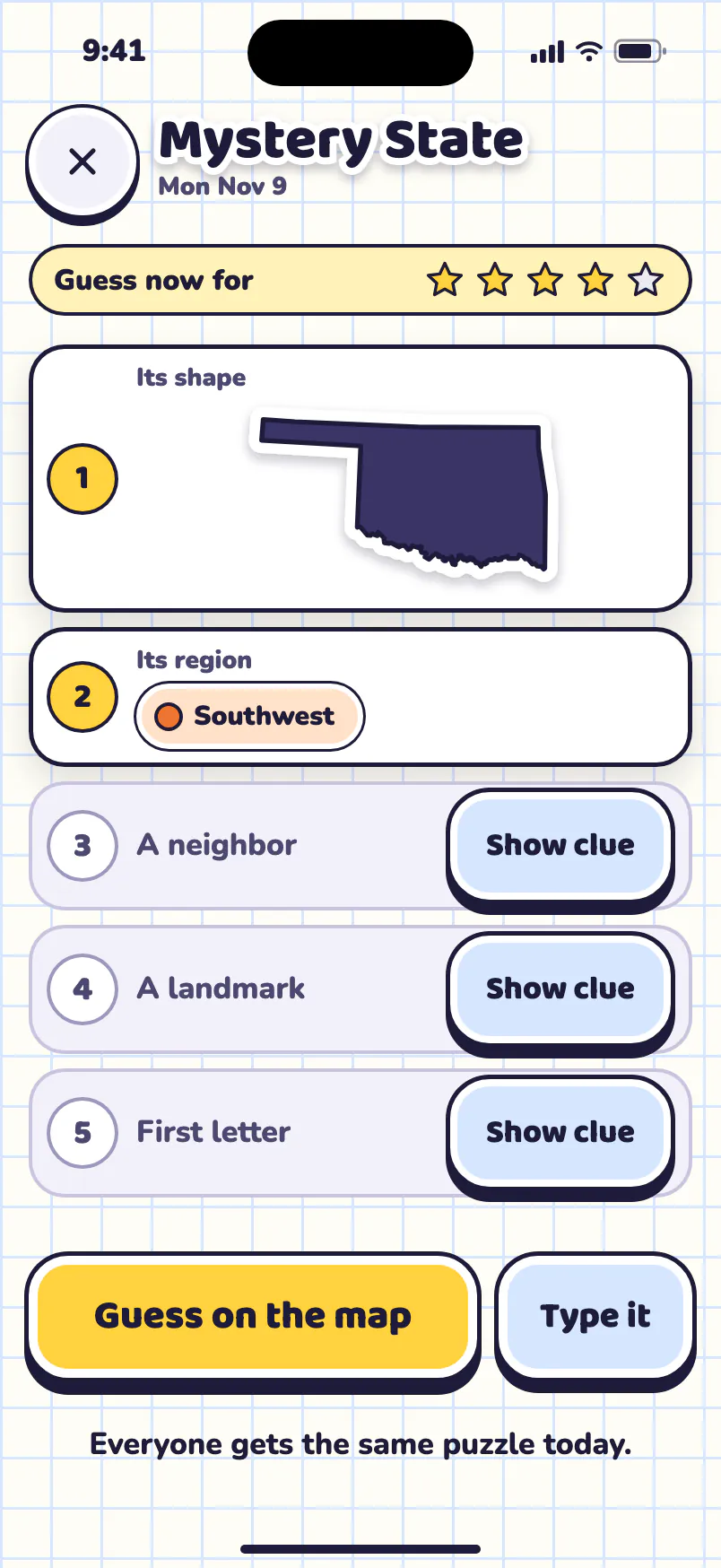
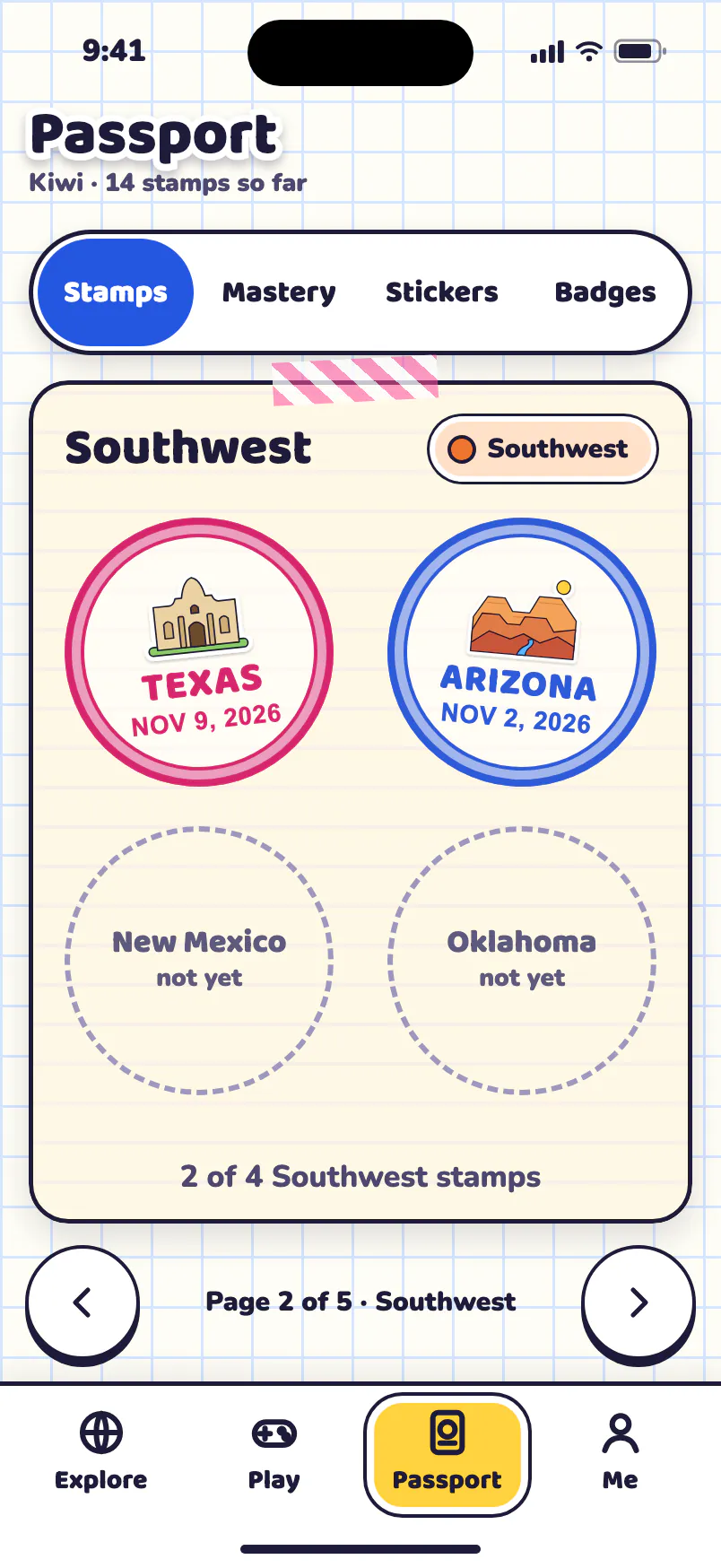
Map Otter is coming soon to iPhone, iPad, Android phones and tablets, and Chromebooks.
Questions kids ask
What is the capital of Tennessee?
Nashville, in Middle Tennessee.
Why is Tennessee called the Volunteer State?
In 1813, during the War of 1812, Tennesseans eagerly answered the governor’s call for volunteers, and that started the tradition. The nickname became official in 2020.
How many states touch Tennessee?
Eight: Kentucky, Virginia, North Carolina, Georgia, Alabama, Mississippi, Arkansas and Missouri. Only Missouri touches as many.
What is the biggest city in Tennessee?
Nashville. It’s the biggest city as well as the capital.
Where these facts come from
- Tennessee Code, Title 4, Chapter 1, Part 3: state symbols (Public.Resource.Org copy of the official code)
- State of Tennessee: state symbols
- National Park Service: Great Smoky Mountains National Park
- National Park Service: synchronous fireflies
- Tennessee Historical Society: State of Franklin
- National Park Service: Cumberland Gap National Historical Park
- Tennessee Historical Society: Pinson Mounds
- Tennessee Historical Society: War of 1812
- National Park Service: Trail of Tears history
- Tennessee Historical Society: Civil War
- National Archives: the 19th Amendment
- US Senate Manual: states admitted into the Union
- National Park Service: what happened on the Trail of Tears
- National Park Service: the Cherokee and the Smokies
- US Census Bureau: state area measurements
- US Census Bureau: state population estimates, 2020 to 2025
- US Census Bureau: city and town population estimates, 2020 to 2025
- US Senate Manual: ratification of the Constitution by the 13 original states
- US Census Bureau: census regions and divisions
- NOAA Office for Coastal Management: shoreline mileage of the United States